

You are comparing two pairs of headphones, and the pair with ANC on the box costs noticeably more. Before you pay for three letters, you want to know what they buy you.
Fair question. The answer is better than a plain yes or no. ANC is excellent against some noises and only fair against others.
I will show you which, using what two headphone makers say about their own products. Then you can match it to the noise in your own day.
What ANC stands for
ANC is short for active noise cancelling. Active means the headphones do something about the noise. They do not just sit in its way.
Bose says how it works on its noise cancelling page. ANC headphones "have two microphones that read and analyze the sounds around you and emit opposite signals to cancel noise when the sound waves collide."
Sony's help guide for its WH-1000XM4 says the same in fewer words. Its circuit "senses outside noise with built-in microphones and sends an equal-but-opposite canceling signal to the headset."
So your headphones make sound in order to remove sound. That is why ANC needs power. With a flat battery, the cancelling stops. Only the padding is left between you and the noise.
What it beats, and what gets through
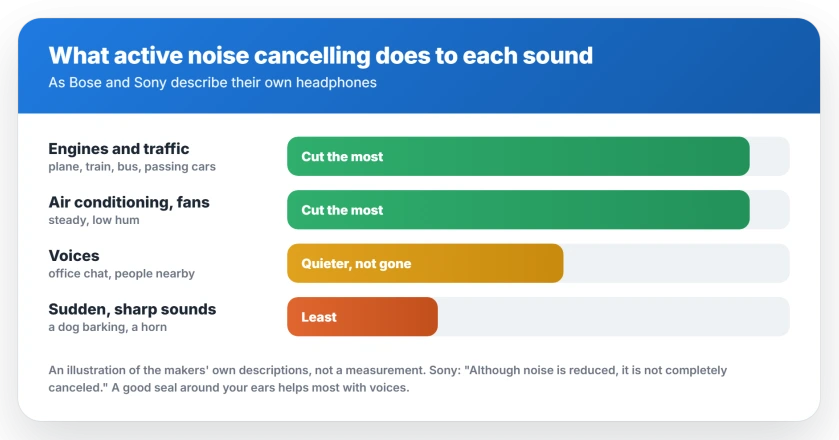
Both makers agree on the strength. Bose says ANC "generally works best for steady low-frequency sounds, like the hum of an air conditioner or passing traffic."
Sony names "vehicles and air conditioning" and adds a line I would print on every box: "Although noise is reduced, it is not completely canceled."
Bose is just as clear about the weak side. ANC "still reduces mid- and high-frequency sounds but not as effectively, especially against sudden and sharp background noise, like a dog barking or horn beeping."
So a plane, a train, a bus or an office fan is what ANC is built for. Switch it on and you will hear those drop away.
Why voices still get through
Bose's page does list "the office chit chat" among the noises ANC removes. Its own next paragraph explains why chat is the harder case.
A voice is not a steady hum. It changes pitch and rhythm all the time. Much of it also sits in the middle frequencies, which Bose says ANC handles "not as effectively".
That explanation is ours, and it matches what you will hear. Voices get quieter, not silent. An open-plan office is a much harder test than a long flight.
The fit does the rest
The other half of quiet is passive. Bose describes passive noise cancelling as something that "merely muffles external sounds by physically covering or filling your ears."
It also says ANC "needs to work alongside passive noise cancelling" for "the best protection from all frequencies". In plain terms, the seal around your ear matters as much as the electronics.
Sony makes the same point from the other side. Depending on how you wear the headset, "the effect of noise canceling may vary". Its fix is simple: take them off and put them on again.
So get the fit right before you judge any pair. With earbuds, try every size of tip in the box.
Three things that feel odd but are normal
A faint hiss in a silent room is the system running. Sony warns that the effect "may not be pronounced in a very quiet environment, or some noise may be heard."
A beep or whistle is feedback. Sony links it to how the headset sits, and to a hand covering the microphones. Reseat them and keep your hands clear.
A feeling of pressure in your ears bothers some people. Others never notice it. If it bothers you, turn the cancelling down or switch to the ambient mode. Bose calls its version Aware Mode, and Sony calls its Ambient Sound Mode.
What to check before you pay extra
Check the battery life with ANC switched on. Makers often quote a longer figure with it off.
Check whether they still play with a flat battery. Sony's guide says that to use the WH-1000XM4 "as ordinary headphones, turn off the headset and use the supplied headphone cable." Plenty of earbuds have no cable option at all.
Check that you can turn it down. Bose says its ANC "is adjustable, allowing you to control how much noise cancellation you want in different situations."
And check the fit on your own ears. No specification sheet can tell you that. Yet it decides half of what you will hear.
When the headphones are the problem, not the noise
ANC gets blamed for faults it did not cause. Muffled or lopsided sound on a PC is not the cancelling. One checkbox in Windows explains most of it.
Cutting out as you walk away is range. And range is not the number printed on the box. Stutter near a microwave comes from the radio band, which other devices in your home share.
A set that will not behave at all needs a proper reset. Most have a button sequence for it.
Status: checked 25 September 2026 against Bose's own noise cancelling explainer, updated June 2026, and Sony's WH-1000XM4 help guide. Both makers say ANC works best on steady low sounds such as engines and air conditioning. Sony adds that noise is reduced, not completely canceled. No headphones were tested for this page.
What does ANC mean on headphones?
Active noise cancelling. Microphones on the headphones listen to the noise around you, and the headphones play an opposite signal to cancel it. Because it is active, it needs power. A flat battery means no cancelling at all.
Does ANC block people talking?
Only partly. Bose says ANC works best on steady low-frequency sound and reduces mid and high frequencies less effectively. Voices get quieter rather than silent, and a good seal around your ears helps with them more.
Why do my noise cancelling headphones hiss?
In a very quiet room you can hear the system itself running. Sony says the effect may not be pronounced in a very quiet environment, or some noise may be heard. Your headphones are fine.
Should I pay extra for ANC?
If your noise is an engine, a fan, a train or traffic, yes, because that is what ANC is built for. If it is mostly people talking, put the fit first, since voices get through any ANC to some degree.
The Short Version
- ANC means active noise cancelling, and it needs power to work.
- Microphones listen to outside noise, and the headphones play an opposite signal.
- Bose and Sony both say it works best on steady low sounds like engines and air conditioning.
- Sony says noise is reduced, not completely canceled.
- Voices and sudden sharp sounds get through more, so the fit matters for them.
- A hiss in a silent room and a beep from a poor fit are normal.
- Before paying extra, check battery life with ANC on, a cable option and a way to turn it down.
Where to Next
Think about the one noise you most want gone. If it hums, drones or rumbles, ANC will earn its price the first time you switch it on.
If it talks, try the fit in a shop before paying extra. The fit is what helps you with voices.
Which noise are you trying to escape? Describe it in the comments. I will say whether ANC is likely to help.

Isaac Smith is the founder and editor of PC Glance, a website that covers computers, laptops, and technology. He is a tech enthusiast and a computer geek who loves to share his insights and help his readers make smart choices when buying tech gadgets or laptops. He is always curious and updated about the latest tech trends.